
Mandatory e-Invoicing 2026‑2027: what French SMEs really need to know (grace period, free platforms, expert advice)
Official timeline & key measures
Introduction: why this reform matters
Mandatory e-invoicing is gradually being rolled out across France. By September 2027, all businesses (micro-enterprises, SMEs, self-employed) will have to send and receive invoices through a partner dematerialization platform (PDP) or the public portal (PPF). The goals? Fight VAT fraud, modernize public administration, and streamline the accounting chain. Many business owners fear an administrative nightmare. But after analyzing the timeline and tools already available, we show that it is possible to approach this transition peacefully, without stress or unnecessary costs.
Economic background: B2B digitalization is a historic acceleration. However, French SMEs often rely on simple invoicing tools, so the switch seems abrupt. Yet free solutions (Qonto, Shine, Indy, Tiiime) already embed compatibility. So, urgency or simple evolution? Full analysis below.
What is mandatory e-invoicing?
The reform imposes on VAT-liable entities to issue and receive invoices in a structured format (UBL or CII standard) via certified platforms or the public invoicing portal (PPF). This will replace PDF email attachments. The dual benefit is automatic data transmission to tax authorities (pre-filled VAT returns) and increased reliability.
Contrary to rumors, you don’t necessarily need to overhaul your entire information system — a simple connection through your online bank or your accounting software often suffices. In fact, many SMEs already use compatible tools without knowing it.
Key measures of the reform (official timeline)
Here are the key deadlines, often a source of confusion:
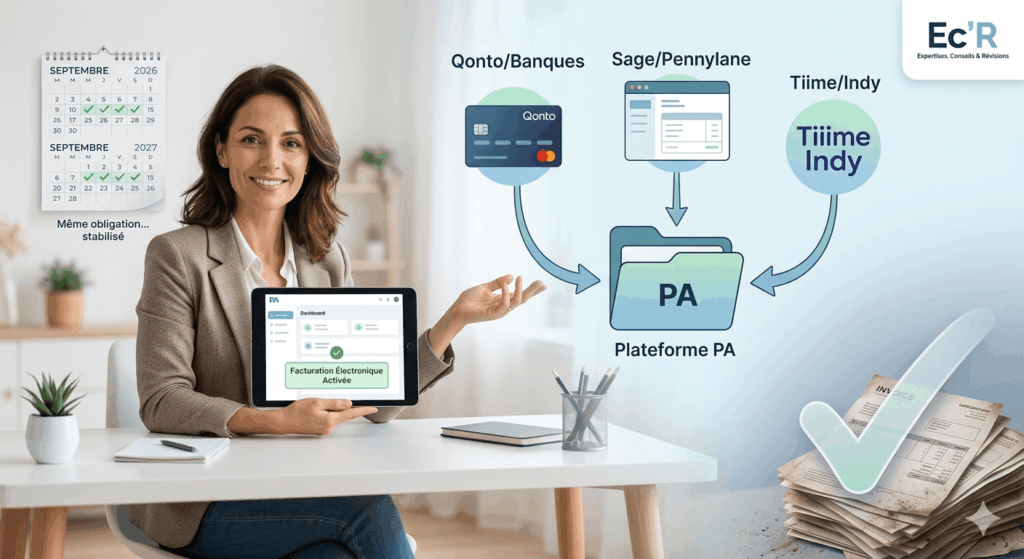
- September 2026: Large companies (ETIs, large accounts) must issue invoices via PDP/PPF.
- September 2027 * : SMEs, micro‑enterprises, self‑employed – same obligation but with a stabilized technical environment.
- * Subject to potential postponement due to technical or electoral factors. But early preparation is wise.
Good to know: the French administration provides a 3‑month grace period without penalties for businesses that haven’t selected a platform by the go‑live date. So don’t panic.
Measures for individuals? Only indirectly…
Private individuals are not directly affected. However, self‑employed professionals (BNC, BIC) are indeed included in the “business” scope from 2027 onward. If you are a consumer buying from professionals, you will receive electronic invoices, but nothing changes on your side.
Concrete measures for SMEs / micro‑companies
1. Obligation to accept e-invoices as of September 2026 if you receive invoices from large accounts (EDF, Orange, major suppliers). Even for smaller firms, you must be connected to a platform by 2026 to receive those invoices.
2. From September 2027: you must issue all B2B invoices via a certified platform.
3. No mandatory software change: your accountant can connect you via their tool (Pennylane, Sage, Quadra). Your online bank (Qonto, Revolut Pro, Shine) also provides a free platform.
Ec’R recommendation: two actions are enough (1) accept the platform offered by your bank or accountant; (2) have a dedicated invoicing tool (leave Word/Excel by 2027).
Important changes vs. common misconceptions
Myth #1: “I absolutely must sign a mandate with my accountant to be compliant”. ➜ Recommended but not blocking. You can go through your bank or a dedicated tool without a mandate.
Myth #2: “I face immediate penalties by September 2026 if not ready”. ➜ FALSE: the administration provides a 3‑month grace period with no penalties after the effective date.
Myth #3: “Self-employed and BNC are not yet registered in the state SIREN directory”. That’s currently true, but it will be resolved by 2027 — the administration is behind, not you.
Our advice: prepare calmly. Priority: choose an online invoicing tool by September 2026 to be ready to receive invoices from large clients.
Recap table: widespread panic vs. SME reality
| What everyone talks about (panic) | The reality for your SME / micro‑business |
|---|---|
| Urgently choose a PDP platform before Sept 2026 | Your online bank or accounting software already does it very likely (for free). |
| Mandatory mandate with your chartered accountant | Recommended but not blocking — do it serenely. |
| Costly and complex upgrades to invoicing tools | Mainly for large accounts with custom ERPs. SMEs can use free tools. |
| Immediate penalties as of Sept 2026 | A 3‑month grace period is provided without penalty. Support is available. |
Economic impact for France: time savings & fraud reduction
Generalized e-invoicing should generate an estimated €4.5 billion yearly savings for businesses, thanks to automation and lower printing/mailing costs. For the State, fighting VAT fraud could bring billions in additional revenue. France joins a virtuous cycle of administrative modernisation, following Italy and Spain. For SMEs, improved payment timelines and fewer disputes (traceable invoices) are also key benefits.
Analysis & Perspectives – by Jean-Marc Zigna, Chartered Accountant
As a Paris‑based chartered accountant (17th arrondissement), I work daily with SMEs. E‑invoicing is not a mountain. The delays announced by the administration, the missing SIREN directory for some self‑employed, show that the State isn’t 100% ready. Software editors (Pennylane, Qonto, Indy, Sage) have anticipated: their connectors already work. The key is to move away from manual Word/Excel invoices by the end of 2026.
Outlook: platforms will become mainstream, and eventually e‑invoicing will feel as natural as sending an email. The Ec’R firm offers a free diagnostic session for a smooth transition.

Chartered Accountant – Firm EXPERTISES, CONSEILS & REVISIONS (Ec’R)
“everything is square — work to the power of two”
FAQ – Mandatory e-invoicing in France
Yes, mainly to receive invoices from large suppliers. Issuing becomes mandatory in 2027. Good news: your online bank (Qonto, Shine, Revolut) offers a free platform to do that.
No. Word/Excel invoices are not in a structured format. You’ll need to switch to a dedicated tool by 2027. Free solutions like Tiiime, Indy are ready.
Yes! Qonto, like most neobanks, is connecting to certified PDPs. Their interface allows you to issue and receive e‑invoices at no extra cost.
A 3‑month grace period without penalty is granted. After that, a fine of €15 per invoice (capped at €15,000/year). Your accountant will guide you before that stage.
Yes, starting September 2027. Currently, the SIREN directory doesn’t fully include them, but it will be fixed by then. No immediate rush.
No, it’s a convenient option since your accountant can manage the connection via their software. But you can stay fully independent via your bank or a free platform.
The authorities announced that companies that haven’t selected a platform by the go‑live date will have 3 months to get compliant without penalties. A real safety net.
The Ec’R firm offers a 30‑minute transition audit. Use our CTA below to book a free appointment or reach us via WhatsApp.
Conclusion: prepare methodically, without panic
Mandatory e‑invoicing is an inevitable shift, but it’s manageable for SMEs. Instead of giving in to urgency alarms, focus on two simple actions: adopt a dedicated invoicing tool (even free) and validate the platform offered by your bank or accountant. The firm EXPERTISES, CONSEILS & REVISIONS (Ec’R) is here to support you in this transition. Don’t wait until the last minute, but move forward calmly.
Ready to switch to e-invoicing smoothly?
Sources & author credentials: LinkedIn Jean-Marc Zigna • Paris Order of Chartered Accountants • OptimRezo profile • Google Maps Ec’R • Facebook firm • YouTube ECR